Why Parents Often Don’t Know Where Their Child Stands Academically

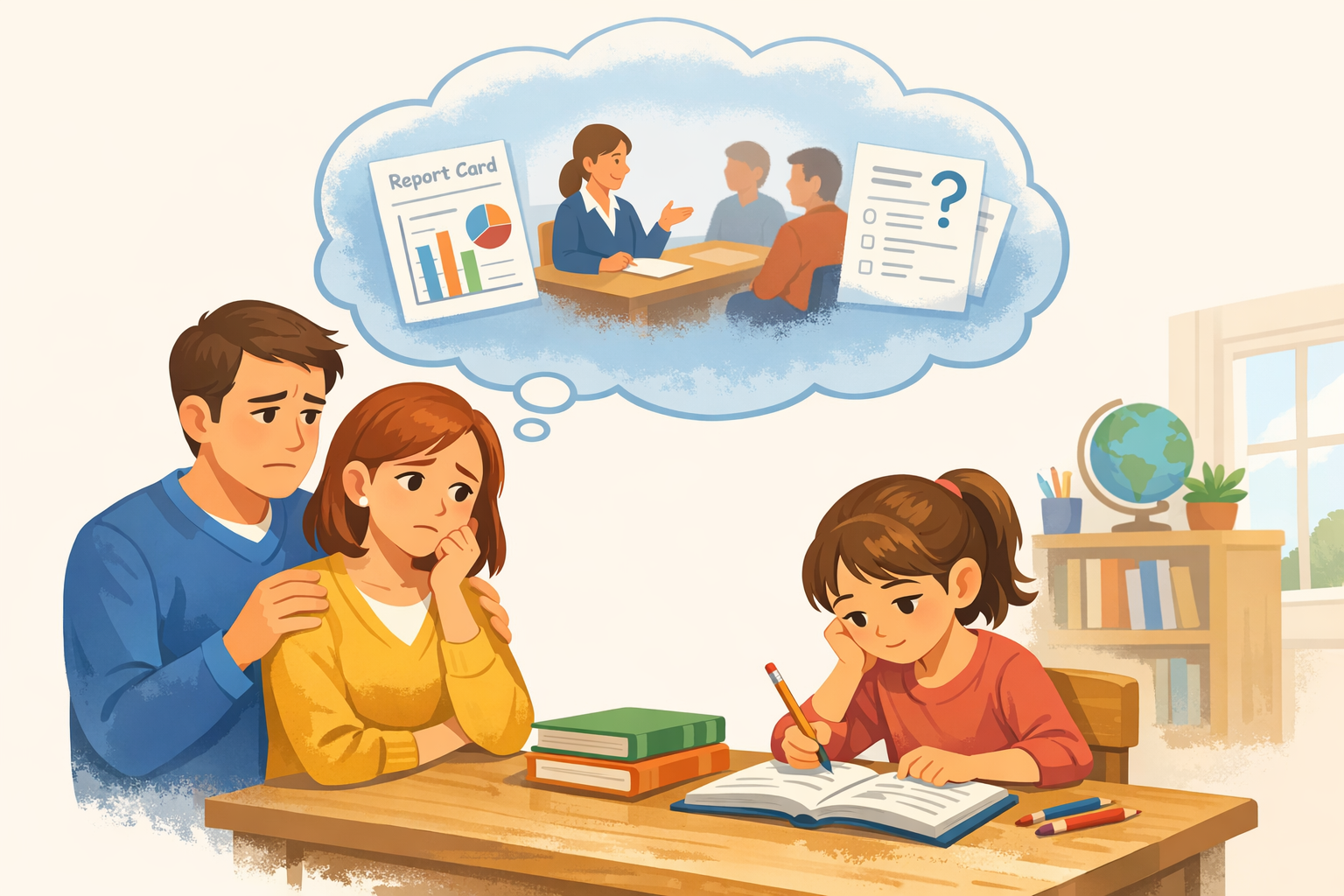
Most parents want to answer a simple question: Is my child doing well at school? Yet for many families, the answer is surprisingly hard to find. A child may bring home decent grades, say that school is “fine,” and still have gaps in reading, writing, math, or study skills that are not obvious until later.
This does not mean parents are not involved. In many cases, parents are doing their best with limited information. The challenge is that modern classrooms move quickly, school communication can be brief, and academic progress is often more complex than a single grade or report card can show.
Grades Don’t Always Tell the Whole Story
One of the biggest reasons parents feel unsure is that grades can be confusing. A “B” in one class may mean a child is meeting grade-level expectations, while a “B” in another class may reflect effort, homework completion, participation, test scores, or a mix of all of these.
Some children also maintain good grades by relying on memorization, help from adults, or last-minute effort. Others may understand the material but lose points because of organization, handwriting, test anxiety, or incomplete assignments. In both cases, the grade alone does not clearly explain what the child truly knows.
A report card is a snapshot, not a full learning map.
Parent-Teacher Conferences Are Often Too Short
Parent-teacher conferences are valuable, but they are usually brief. Teachers may have only 10 to 15 minutes to summarize months of learning, behavior, strengths, challenges, and next steps. That is a lot to cover in a short conversation.
Teachers also need to speak carefully and constructively. Instead of saying, “Your child is significantly behind in fractions,” a teacher may say, “We are still working on number concepts.” Parents may leave the meeting thinking everything is mostly fine, when the child actually needs targeted support.
Children Don’t Always Know How to Explain Their Learning
When parents ask, “How was school?” many children answer with “Good,” “Fine,” or “I don’t know.” This is normal. Children often struggle to describe what they learned, what they found difficult, or whether they are behind their peers.
Younger children may not have the vocabulary to explain academic challenges. Older students may avoid the topic because they feel embarrassed, stressed, or afraid of disappointing their parents. Some children genuinely believe they understand a topic until they are asked to apply it independently.
Learning Gaps Can Stay Hidden for a Long Time
Academic gaps do not always appear suddenly. They often build quietly over time. A child who misses key phonics skills in early reading may later struggle with comprehension. A student who does not fully understand multiplication may have difficulty with fractions, ratios, and algebra.
Because school curricula build from one concept to the next, small gaps can become bigger obstacles. Parents may not notice until homework becomes stressful, test scores drop, or the child begins saying, “I’m just bad at math” or “I hate reading.”
Homework May Not Reflect Independent Ability
Homework can be another unclear signal. Some children complete homework easily because it is simpler than classroom assessments. Others complete it with help from parents, siblings, tutors, or online tools. In these cases, homework may look correct even when the child cannot do the same work alone.
On the other hand, a child may struggle with homework because they are tired after school, distracted at home, or unsure how to manage time—not necessarily because they do not understand the subject. That is why homework should be considered one clue, not the entire answer.
Standardized Test Scores Can Be Hard to Interpret
Many schools provide standardized test results, but parents may not receive enough explanation. Percentiles, grade equivalents, benchmark levels, and scaled scores can feel technical. A child might be “meeting expectations” overall while still needing support in a specific skill area, such as inference, measurement, grammar, or multi-step problem solving.
Parents need more than a score. They need to know what the score means, which skills are secure, which skills need practice, and what to do next.
What Parents Can Look For at Home
Parents do not need to become teachers to understand their child’s academic position. A few simple observations can reveal a lot.
Reading: Does your child read smoothly, understand what they read, and explain the main idea in their own words?
Writing: Can your child organize ideas, write complete sentences, and revise their work?
Math: Can your child explain the steps, not just get the answer?
Study habits: Does your child know how to prepare for tests without being reminded constantly?
Confidence: Does your child avoid certain subjects or say they are “not good” at them?
Questions That Give Parents Better Answers
Instead of asking only whether a child is passing, parents can ask more specific questions during school meetings or email communication.
What skills is my child expected to master this term?
Which areas are strongest right now?
Which skills need more practice?
Is my child working at, above, or below grade level?
What can we do at home for 10 to 15 minutes a day?
How will we know if progress is improving?
These questions help shift the conversation from general impressions to clear next steps.
How EiFO Academy Helps Make Learning Visible
At EiFO Academy, we believe parents should not have to guess where their child stands. As an online K-12 education platform, our goal is to make learning more visible through structured lessons, skill-based support, and regular feedback that helps families understand progress over time.
When children receive the right support early, they can rebuild confidence and close learning gaps before they become overwhelming. Just as importantly, parents gain a clearer picture of what their child understands, where they need help, and how to support them with less stress.
Parents often do not know exactly where their children are academically because the signals are incomplete. Grades, homework, conferences, and test scores each show part of the story, but not the whole picture.
The solution is not to worry more—it is to ask better questions, observe patterns, and seek learning support that identifies specific strengths and gaps. With clear information and consistent guidance, parents can move from uncertainty to confidence, and children can get the support they need to succeed.