Why AI in Education Needs Strong Guardrails Before It Enters the Classroom

Artificial intelligence is quickly becoming part of everyday life, including education. AI tools can explain math problems, generate reading passages, translate languages, and even act like a personal tutor. For K-12 learners, that sounds exciting—and it can be. But when children are involved, “new” and “powerful” are not enough. Education requires safety, accuracy, fairness, and trust.
At EiFO Academy, we believe technology should support children, not experiment on them. AI models can be useful learning companions, but only when they are carefully designed, monitored, and protected by strong guardrails. Without those safeguards, AI can create problems that affect how children learn, think, and feel.
AI Models Are Not the Same as Teachers
AI models are trained on large amounts of data and predict responses based on patterns. They do not truly understand a child’s emotions, home context, learning history, or developmental needs the way a skilled teacher or caring adult can. An AI may sound confident, but confidence is not the same as correctness.
This matters because children are still developing judgment. A student may assume that a polished AI answer is always accurate. If the tool gives a wrong explanation, an unsafe suggestion, or a biased example, the child may not know how to question it.
In education, a helpful answer must be more than fast. It must be accurate, age-appropriate, fair, and aligned with learning goals.
The Main Risks of AI in K-12 Education
1. Misinformation can become “learning”
AI tools can produce incorrect facts, flawed reasoning, or made-up sources. This is sometimes called a hallucination. In a casual setting, a wrong answer may be inconvenient. In education, it can become part of a child’s understanding and be difficult to correct later.
2. Bias can shape a child’s worldview
AI models learn from data created by people, and human data can contain stereotypes or unfair patterns. If not carefully tested, an AI may present biased examples, make unfair assumptions, or underrepresent certain cultures, communities, or learning styles. Children deserve learning materials that are inclusive and respectful.
3. Privacy risks are especially serious for children
Students may type personal information into a tool without understanding the consequences. They might mention their school, family, location, struggles, or emotions. Educational AI must be designed to protect children’s data, minimize collection, and prevent sensitive information from being stored or misused.
4. Overdependence can weaken independent thinking
If AI gives instant answers, students may rely on it instead of practicing problem-solving. Learning often requires productive struggle: trying, making mistakes, revising, and building confidence. When AI skips that process, children may complete tasks without developing the underlying skills.
5. Emotional attachment and misplaced trust can develop
Some AI tools are conversational and friendly. For children, that can blur the line between a learning tool and a trusted human relationship. AI should never replace teachers, parents, mentors, counselors, or healthy peer interaction.
Why Guardrails Are Necessary
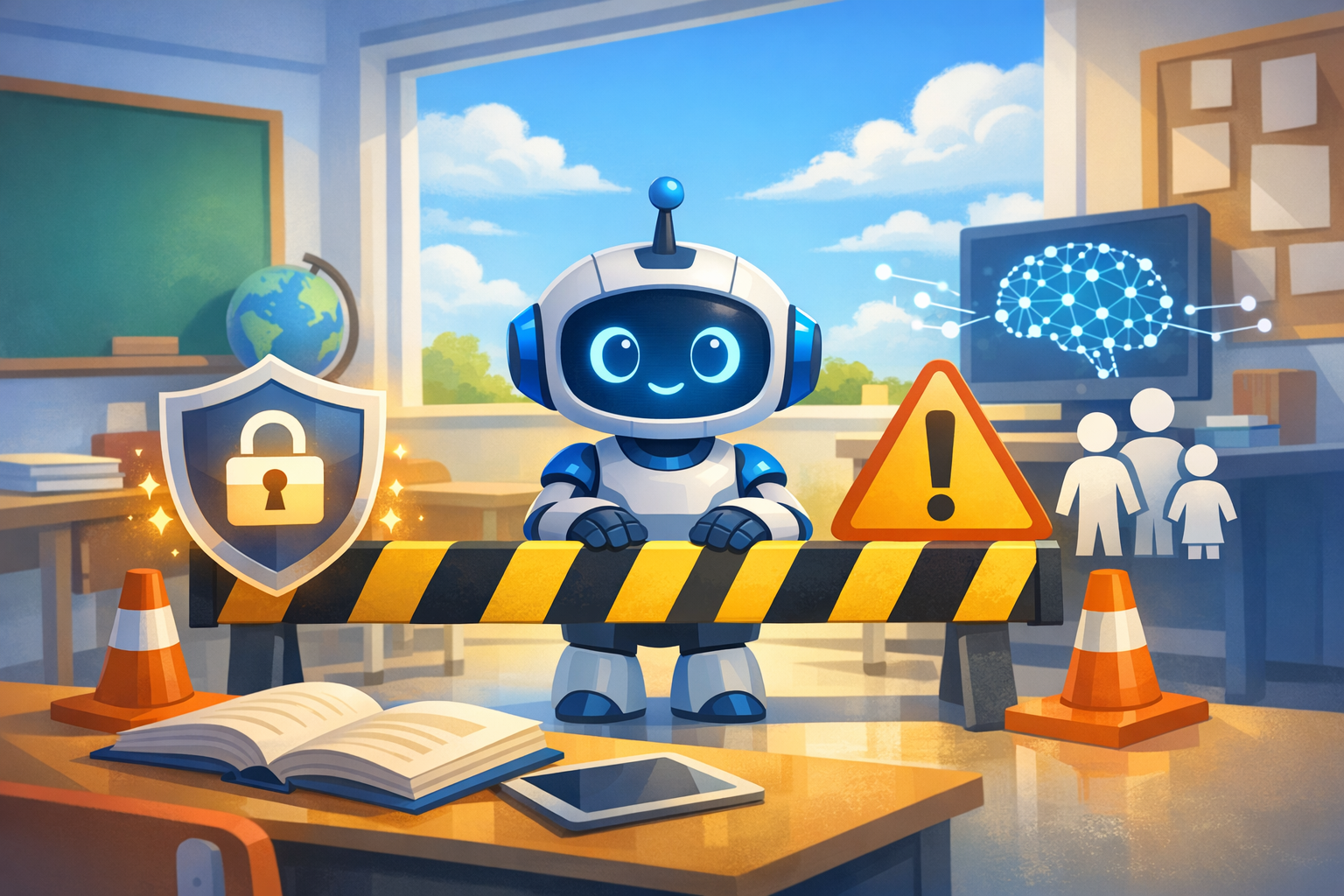
Guardrails are rules, systems, and human oversight mechanisms that guide how AI behaves. They help prevent harm and keep the technology focused on safe learning. In education, guardrails are not optional extras. They are essential.
Strong guardrails should answer important questions: What can the AI say? What should it refuse to do? How does it handle sensitive topics? How is student data protected? Who reviews mistakes? How do teachers and parents stay informed?
| Risk | Needed Guardrail |
|---|---|
| Incorrect answers | Curriculum-aligned content, fact-checking, and clear uncertainty notices |
| Unsafe or mature content | Age-appropriate filters and topic restrictions |
| Student privacy concerns | Data minimization, secure storage, and child-safe privacy policies |
| Bias and unfair examples | Regular bias testing and diverse content review |
| Overreliance on answers | Step-by-step guidance that encourages thinking, not copying |
What Good AI Guardrails Look Like in Education
Age-appropriate design
A tool for a 7-year-old should not behave like a tool for a 17-year-old. Vocabulary, examples, emotional tone, and allowed topics should match the learner’s age and maturity level.
Human-in-the-loop oversight
Teachers, curriculum experts, and platform moderators should review how AI is used. AI should support educators, not remove them from the learning process. When a child struggles, needs encouragement, or asks a sensitive question, human guidance remains vital.
Transparent limitations
Children and families should understand that AI can make mistakes. A responsible platform should clearly explain when AI is being used and encourage students to verify information, ask questions, and seek help from trusted adults.
Privacy-first systems
AI in education must collect as little personal data as possible. It should avoid unnecessary profiling and protect children from data exposure. Families should know what information is collected, why it is collected, and how it is protected.
Learning-focused responses
The goal of educational AI should not be to simply give answers. Better AI helps students think. It can ask guiding questions, offer hints, explain concepts in multiple ways, and encourage reflection.
The Role of Parents and Educators
Even with strong technology safeguards, adults play a key role. Parents and teachers can help children develop healthy AI habits by discussing how AI works, when to use it, and when not to rely on it.
- Ask children to explain their reasoning instead of only showing the final answer.
- Encourage fact-checking with books, teachers, and trusted educational resources.
- Set boundaries around when AI can be used for homework or practice.
- Watch for overdependence if a child becomes unwilling to try without AI help.
- Talk about privacy and remind children not to share personal details with digital tools.
AI Can Help Education, But Safety Must Come First
AI has real potential. It can provide extra practice, support multilingual learners, personalize review activities, and help teachers save time. But children are not test subjects for unproven technology. Before AI becomes a regular part of education, platforms must build systems that protect learners first.
For EiFO Academy, responsible innovation means combining technology with child-centered values. AI should be accurate, respectful, private, age-appropriate, and guided by educators. Most importantly, it should strengthen a child’s ability to learn—not replace curiosity, creativity, effort, or human connection.
Final thought: AI in education is not dangerous because it exists. It becomes dangerous when it is used without responsibility. With strong guardrails, transparent policies, and human oversight, AI can become a safer support system for learning. Without them, it can put children’s knowledge, privacy, and development at risk.