What Should a 4th Grader's Writing Look Like? Examples & Expectations

By fourth grade, students should be moving beyond simply writing correct sentences. They should be learning to organize ideas into paragraphs, develop ideas with meaningful details, vary their sentences, and revise their writing.
A typical 4th grader should be developing these 5 skills:
Clear focus — The writing stays on one main topic.
Organized paragraphs — Ideas appear in a logical order rather than as one long block.
Elaboration — Important ideas are explained with details, examples, descriptions, or evidence.
Stronger sentences — Sentences vary in length and structure instead of repeatedly using “I... I... I...”
Revision — The final draft improves the ideas and organization, not just spelling and handwriting.
What does stronger 4th-grade writing look like?
Instead of:
I was nervous before the game.
A developing fourth-grade writer might write:
My stomach felt tight as I waited for the referee to blow the whistle. I had practiced for weeks, but suddenly I couldn't stop thinking about everything that might go wrong.
The second version doesn't just tell the reader what happened. It develops the idea.
How Many Sentences Should a 4th Grader Be Able to Write?
There is no fixed number of sentences every fourth grader must write. By Grade 4, students should be developing organized paragraphs and learning to connect them into longer pieces of writing.
A strong paragraph typically includes a clear main idea, supporting details, and an explanation or conclusion. For longer assignments, students should be learning to organize multiple paragraphs.
Quality matters more than length. Five well-developed sentences can demonstrate stronger writing skills than ten repetitive or disconnected sentences.
What Does Real 4th-Grade Writing Look Like?
Here is an example from an actual 4th-grade student. The student has a clear opinion and several ideas to support it, but the writing is still developing in organization, sentence structure, evidence, and conventions.
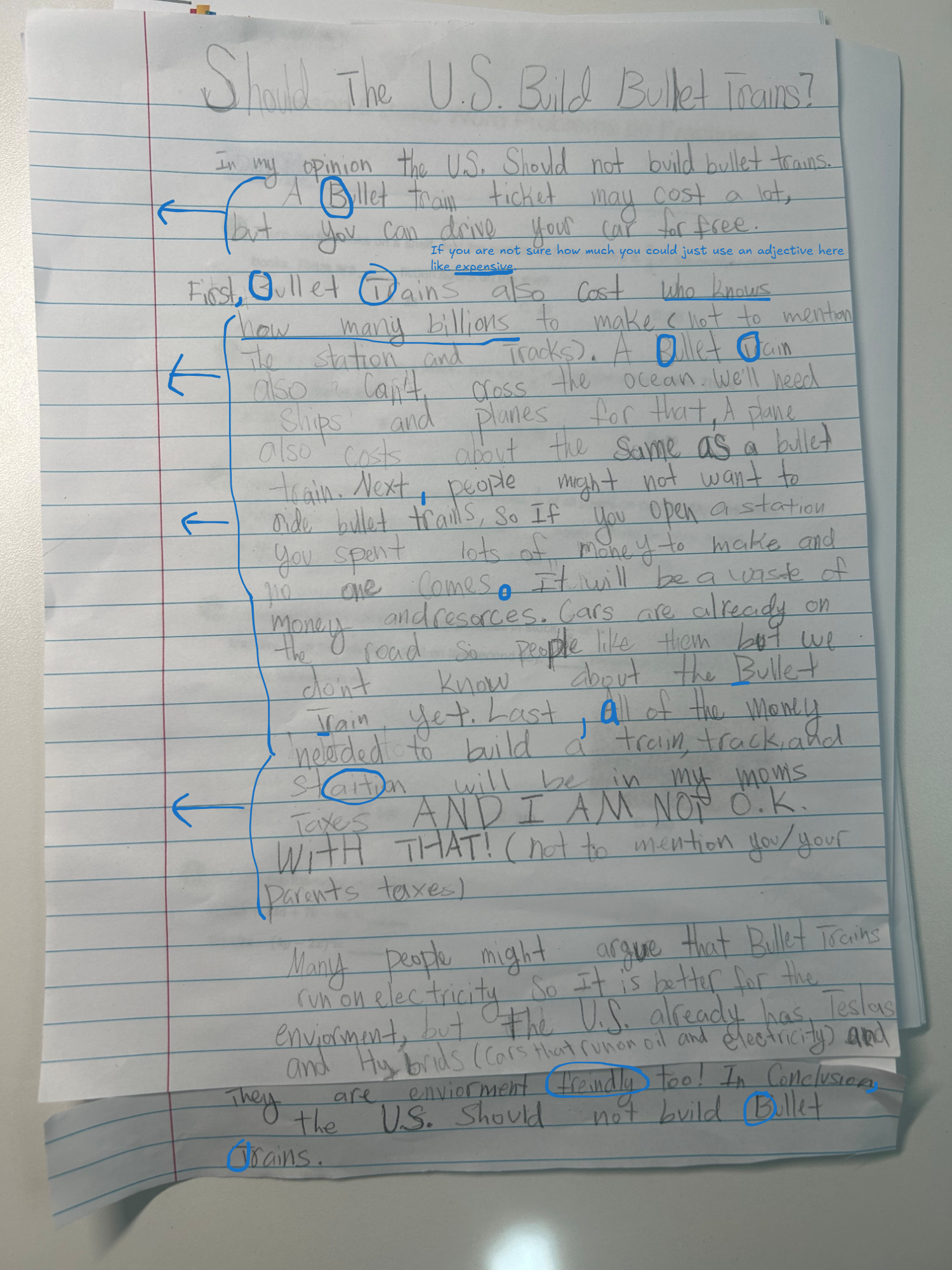
These are important writing skills students begin developing as they move from simply expressing an opinion to building a supported argument.
Feedback Helps Students See What to Improve
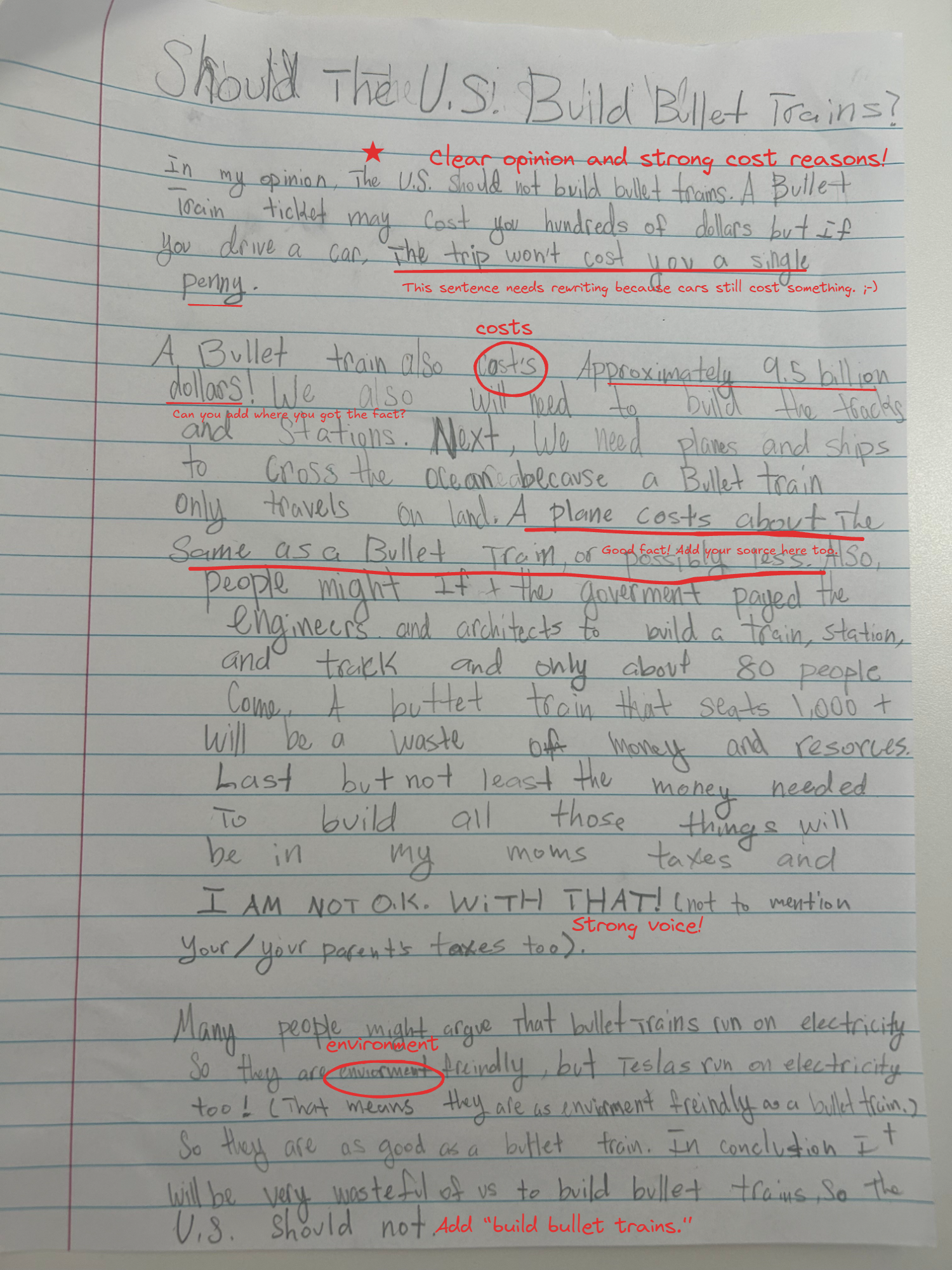
At the same time, the teacher identifies specific next steps—such as adding sources for factual claims, improving unclear reasoning, correcting word usage, and strengthening the conclusion.
This is why looking only at grammar mistakes doesn't tell parents whether a child is a strong writer. Good writing instruction develops the ideas as well as the sentences.
Common problems we see in 4th-grade writing
Parents may notice:
• very short or undeveloped paragraphs
• ideas that jump from topic to topic
• repetitive sentences
• run-on sentences
• details that don't support the main idea
• inconsistent verb tense
• weak beginnings or endings
• a “final draft” that is essentially a clean copy of the first draft
One important point: longer doesn't always mean better.
A full page of writing can still be weak if the ideas aren't organized or developed. A shorter piece with a clear focus, strong details, and purposeful sentences may demonstrate much stronger writing skills.
How Can Parents Improve 4th-Grade Writing Skills?
Parents can help children become stronger writers with a few simple habits:
Ask “Why?” and “How?” Encourage children to explain their ideas rather than simply stating them.
Request specific details. Instead of writing “The trip was fun,” ask what made it memorable.
Practice meaningful revision. Have children improve one part of their writing at a time, such as adding details, organizing ideas, or clarifying sentences.
The goal isn't to make every sentence perfect. It's to help children become more confident, thoughtful, and independent writers.
How can I tell where my child stands?
Instead of counting spelling errors, ask:
Can I identify the main idea?
Are the ideas organized logically?
Does my child explain important ideas with enough detail?
Do the sentences sound natural and varied?
Did the final draft meaningfully improve on the first draft?
Fourth graders develop at different rates, so grade level alone doesn't tell the whole story. Looking at what a student can write independently gives a much clearer picture.
Not sure where your child's writing stands?
EiFO Academy offers small-group writing instruction focused on developing ideas, organization, sentence structure, revision, and independent writing.
Explore EiFO Academy's Writing Programs: Course Catalog | EiFO Academy