Does My Child Need Reading Help, Writing Help, or Both?

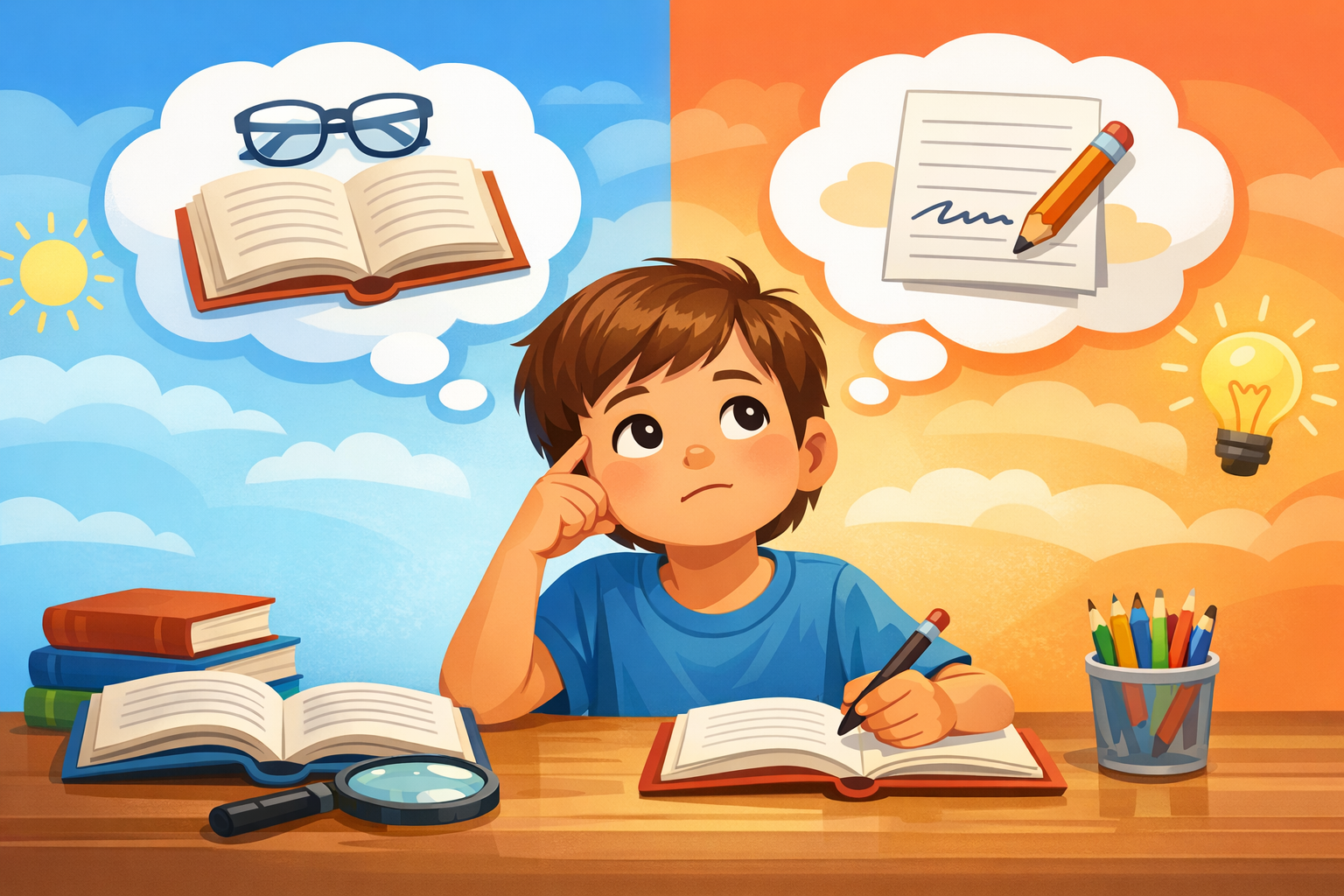
When a child struggles with schoolwork, it can be hard to tell where the real challenge begins. Is your child having trouble reading the words on the page? Organizing ideas into sentences? Understanding what they read? Or all of the above?
For many families, the answer is not immediately obvious because reading and writing are closely connected. A child who reads slowly may also avoid writing assignments. A child who has wonderful spoken ideas may freeze when asked to put them on paper. Understanding the difference can help you get the right support sooner.
Why Reading and Writing Are So Connected
Reading and writing are like two sides of the same literacy coin. Reading helps children recognize vocabulary, sentence patterns, story structure, and information. Writing asks them to use those same skills actively: choosing words, building sentences, organizing ideas, and checking meaning.
Because they share many underlying skills, a weakness in one area can affect the other. For example, a child who struggles to decode words may not read enough to build a strong vocabulary. Later, that smaller vocabulary can make writing feel harder. Similarly, a child who has difficulty understanding sentence structure may struggle both to comprehend complex texts and to write clear paragraphs.
Signs Your Child May Need Reading Help
Reading support may be the priority if your child has difficulty recognizing words, understanding text, or reading fluently. Watch for patterns over time, not just one difficult homework night.
- Reads much more slowly than classmates or siblings at the same age
- Guesses words based on the first letter or picture instead of sounding them out
- Skips, adds, or reverses words while reading
- Avoids reading aloud or becomes frustrated quickly
- Has trouble retelling what happened in a story or explaining the main idea
- Struggles with phonics, sight words, or spelling patterns
- Can read individual words but has difficulty understanding paragraphs or chapters
Some children are strong decoders but weak comprehenders. Others understand stories when someone reads to them but struggle to read independently. Both situations can call for reading help, but the type of instruction should be different.
Signs Your Child May Need Writing Help
Writing support may be the priority if your child has ideas but cannot express them clearly in written form. Writing challenges can appear in spelling, grammar, handwriting, sentence structure, paragraph organization, or confidence.
- Has trouble starting writing assignments, even when they understand the topic
- Writes very little compared with what they can say out loud
- Uses incomplete sentences or run-on sentences often
- Struggles to organize ideas into a beginning, middle, and end
- Repeats the same words or sentence patterns
- Makes frequent spelling, punctuation, or capitalization errors
- Becomes upset, distracted, or avoidant when asked to write
It is common for children to say, “I don’t know what to write,” when the real issue is not imagination but structure. They may need explicit instruction in planning, sentence building, paragraph development, and revision.
When Your Child May Need Both
Many children benefit from support in both reading and writing because the skills reinforce each other. If your child has difficulty understanding what they read and also struggles to write about it, both areas may need attention.
Your child may need combined literacy support if they:
- Have trouble reading grade-level texts and writing grade-level responses
- Struggle with spelling in both reading and writing tasks
- Can discuss ideas verbally but cannot connect them to written text
- Avoid both independent reading and writing assignments
- Perform better in math or hands-on subjects than in language-based subjects
Combined support does not mean overwhelming your child with more work. A strong program can integrate reading and writing together. For example, a student might read a short passage, identify the main idea, learn key vocabulary, and then write a guided response using sentence frames.
A Simple Comparison for Parents
| If you notice... | It may point to... |
|---|---|
| Your child reads slowly, guesses words, or avoids reading aloud | Reading fluency or decoding support |
| Your child reads the words but cannot explain the meaning | Reading comprehension support |
| Your child has ideas verbally but writes very little | Writing planning and expression support |
| Your child writes disorganized paragraphs or unclear sentences | Writing structure and grammar support |
| Your child struggles with both written assignments and reading tasks | Integrated reading and writing support |
Questions to Ask Before Choosing Support
Before deciding whether your child needs reading help, writing help, or both, gather a little evidence. You do not need to diagnose the problem yourself, but you can observe patterns.
- What is hardest: reading the words, understanding the text, or writing a response?
- Can my child explain ideas out loud more easily than in writing?
- Does my child avoid certain assignments consistently?
- Are the struggles new, or have they appeared across multiple school years?
- What feedback has the teacher given about reading level, writing quality, or classroom participation?
If possible, save samples of your child’s reading assignments, writing pieces, spelling tests, and teacher comments. These examples can help an instructor identify the most important starting point.
How EiFO Academy Supports Reading and Writing Growth
At EiFO Academy, we understand that every child’s literacy profile is different. Some students need help building confidence with phonics and fluency. Others need strategies for comprehension, vocabulary, essay writing, grammar, or organization. Many need a thoughtful combination.
Our online K-12 learning support is designed to meet students where they are and help them move forward step by step. Instead of giving children generic worksheets, effective literacy instruction should target the skills they need most, provide guided practice, and celebrate progress along the way.
The goal is not just to help a child finish tonight’s assignment. The goal is to build the reading and writing skills that make future assignments feel possible.
What Parents Can Do at Home
Even before formal support begins, small routines can make a meaningful difference.
- Read together regularly. Take turns reading pages, or let your child listen while following along.
- Talk about books and articles. Ask, “What happened?” “Why did that matter?” and “What do you think will happen next?”
- Use writing in real life. Encourage your child to write shopping lists, thank-you notes, journal entries, or short reviews.
- Separate ideas from editing. Let your child get thoughts down first, then revise spelling and grammar later.
- Praise effort and strategy. Notice when your child rereads, plans, asks questions, or improves a sentence.
The Bottom Line
If your child is struggling, you do not have to choose blindly between reading help and writing help. Look at the specific signs: word reading, comprehension, idea generation, sentence structure, organization, spelling, and confidence. In many cases, the best support connects reading and writing so your child can grow as a complete communicator.
With the right guidance, children can move from frustration to confidence. Whether your child needs reading help, writing help, or both, early and targeted support can make school feel less stressful and learning feel more achievable.