The Scientific Method: A Simple Framework for Raising Curious, Confident Learners

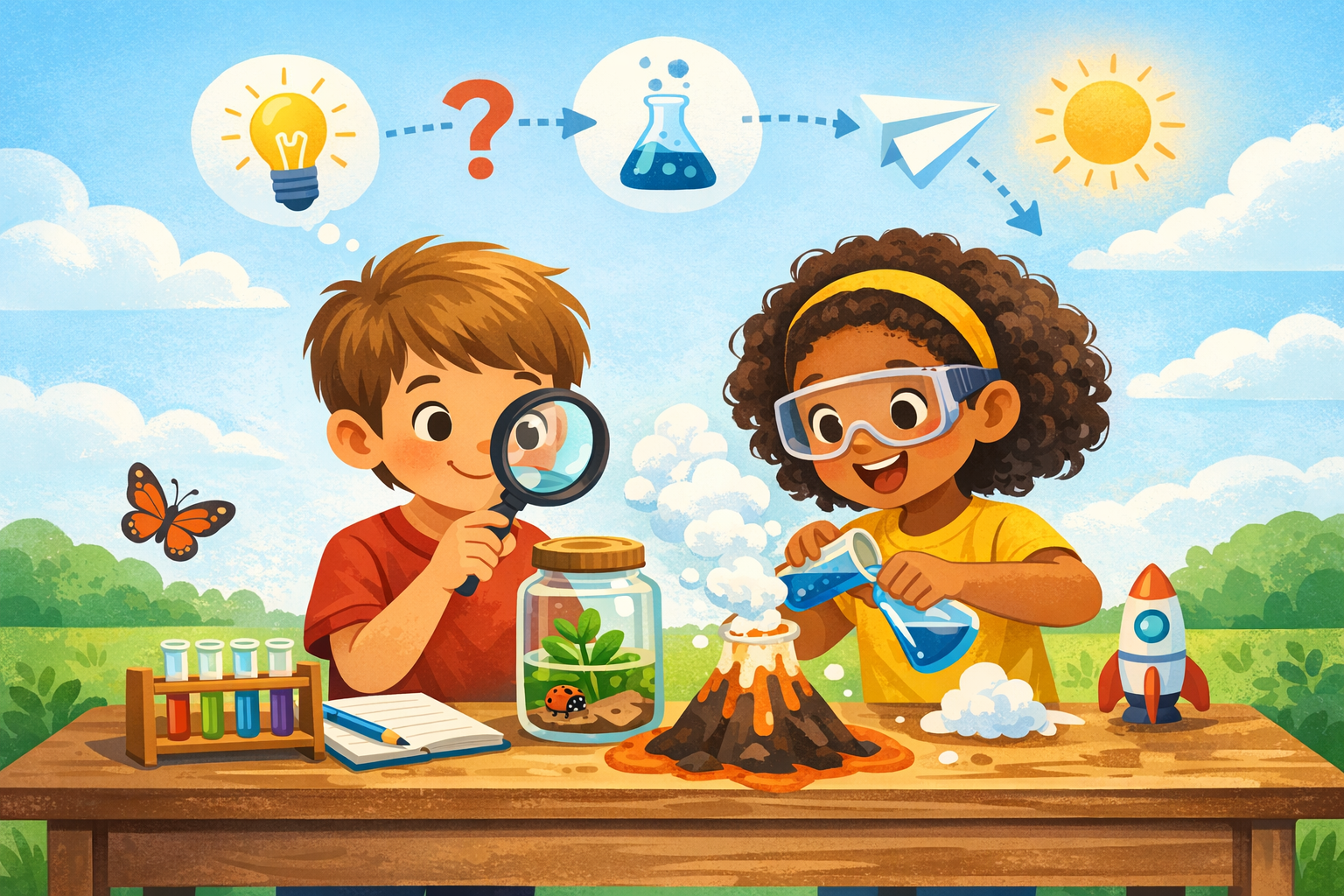
Every child is born a scientist. Before they can name it, they observe, experiment, predict, test, and revise. A toddler drops a spoon from a high chair again and again, not simply to make a mess, but to understand cause and effect. A student wonders why the moon changes shape, why plants lean toward windows, or why some stories make us feel brave. Curiosity is the beginning of learning.
At EiFO Academy, we believe education should help students protect that curiosity while giving it structure. The scientific method does exactly that. It teaches children the art of thinking: how to wonder, investigate, reason, adapt, and keep seeking understanding. Far from trapping imagination, it gives imagination a path to travel.
What Is the Scientific Method, Really?
Many students first meet the scientific method as a list of steps: ask a question, form a hypothesis, test it, observe results, and draw a conclusion. That list is useful, but the deeper value is not memorizing the steps. The deeper value is learning how to approach the unknown.
The scientific method teaches students to say:
- I notice something. Observation comes before opinion.
- I wonder why. Questions are welcomed, not rushed away.
- I have an idea. A hypothesis is a thoughtful guess, not a final answer.
- I can test it. Learning becomes active instead of passive.
- I may need to change my mind. New evidence is a reason to grow.
In this way, the scientific method becomes more than a tool for science. It becomes a mindset for life.
It Grounds Thinking Without Limiting Imagination
Some people worry that too much structure can make learning feel rigid. But the scientific method does not tell students what to imagine. It helps them explore their imagination with clarity. A child can dream of building a rocket, writing a fantasy world, designing a game, or solving a community problem. The scientific method asks: What do you notice? What do you want to know? How might you find out? What can you try next?
That structure is not a cage. It is a bridge between wonder and understanding.
The scientific method does not shrink a child’s imagination. It gives that imagination tools, direction, and confidence.
When students learn to test ideas, they also learn that being wrong is not failure. It is feedback. This is one of the most powerful lessons a child can carry into academics, relationships, creativity, and future careers.
How the Scientific Method Builds Lifelong Learners
Lifelong learners are not people who already know everything. They are people who enjoy discovering what they do not know yet. The scientific method nurtures that habit because it rewards curiosity, patience, and reflection.
1. It teaches students to ask better questions
Strong learning begins with strong questions. Instead of only asking, “What is the answer?” students learn to ask, “How do we know?” and “What evidence supports that idea?” These questions lead to deeper thinking in science, math, reading, history, and everyday decision-making.
2. It helps students become comfortable with uncertainty
Children often feel pressure to be correct quickly. The scientific method shows them that not knowing is a normal part of learning. A hypothesis can be revised. A test can be improved. A conclusion can change. This helps students develop resilience and intellectual humility.
3. It strengthens problem-solving skills
Whether a student is debugging code, improving an essay, solving a word problem, or preparing for a debate, the same thinking process applies: identify the problem, try a strategy, study the result, and adjust. Scientific thinking turns challenges into puzzles that can be approached step by step.
4. It connects knowledge across subjects
The scientific method is not limited to laboratories. In literature, students can form interpretations and support them with evidence from the text. In history, they can examine sources and compare perspectives. In math, they can test patterns and refine strategies. In art, they can experiment with technique, color, and form. The method teaches students that knowledge is connected.
A Classroom Example: From Curiosity to Understanding
Imagine a student asks, “Why do some seeds grow faster than others?” A traditional approach might provide an explanation and move on. A scientific-method approach invites the student into the learning process.
- Question: Why do some seeds grow faster than others?
- Hypothesis: Maybe seeds with more sunlight grow faster.
- Experiment: Plant seeds in similar soil, give them the same water, but place them in different amounts of light.
- Observation: Measure growth each day and record changes.
- Conclusion: Decide whether the evidence supports the hypothesis.
- Next question: What about water, soil type, or temperature?
Notice what happens here. The student is not just receiving information. The student is practicing attention, organization, patience, measurement, reasoning, and communication. Most importantly, one answer leads to another question. That is the heartbeat of lifelong learning.
How Parents and Teachers Can Encourage Scientific Thinking
Children do not need expensive equipment to practice the scientific method. They need adults who value questions and create room for exploration. Here are simple ways to begin:
- Ask, “What do you notice?” before explaining what is happening.
- Encourage predictions with, “What do you think will happen next?”
- Celebrate thoughtful mistakes by saying, “What did that teach us?”
- Invite evidence with, “How do you know?”
- Connect learning to real life through cooking, weather, gardening, building, reading, and play.
These small moments help children see learning as an active process. They also teach that intelligence is not fixed. Understanding grows through effort, reflection, and curiosity.
The EiFO Academy Approach
At EiFO Academy, our goal is not only to help students master academic content. We want to help them become thoughtful, curious, adaptable learners. The scientific method supports that mission because it builds habits students can use long after a lesson ends.
When children learn how to think scientifically, they learn how to slow down, look closely, ask meaningful questions, and seek evidence. They learn that creativity and logic are not opposites. They learn that imagination can be both free and focused.
Most of all, they learn that the world is understandable, fascinating, and worth exploring.
Final Thought
The scientific method shaped the way many lifelong learners view the world because it offers a balanced gift: wonder with discipline, creativity with evidence, and confidence with humility. It grounds thinking, but it does not trap it. For students, that may be one of the most important lessons of all.
When we teach children the scientific method, we are not just preparing them for science tests. We are helping them become learners who crave knowledge, seek understanding, and carry curiosity into every part of life.